Long-Term Vision
Target Corporate Profile
A Value Co-Creation Company
A company that defines and
creates value together
with its customers
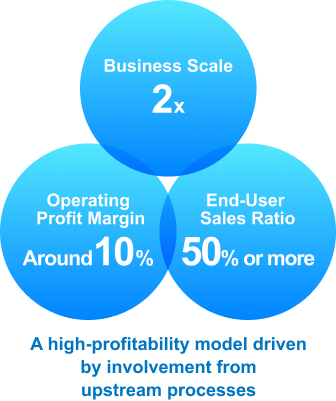
Medium-Term Management Plan “Re: Growth 2028”
Re:Growth 2028
Period: April 2026 – March 2029

Starting point for returning to a growth trajectory
Positioning of This Medium-Term Management Plan
- A three-year starting point for sustainable growth that does not set a fixed target date for achieving the Long-Term Vision to respond to changes in the business environment
- An investment phase aimed at future earnings growth
- A dual approach: Expanding a stable earnings base (Integration Business) and taking on and creating new growth areas (Solutions Business)
Strengthening the management foundation and transforming the business structure toward “Re: Growth”
Monitoring Indicators
*Operating profit before amortization of goodwill and depreciation
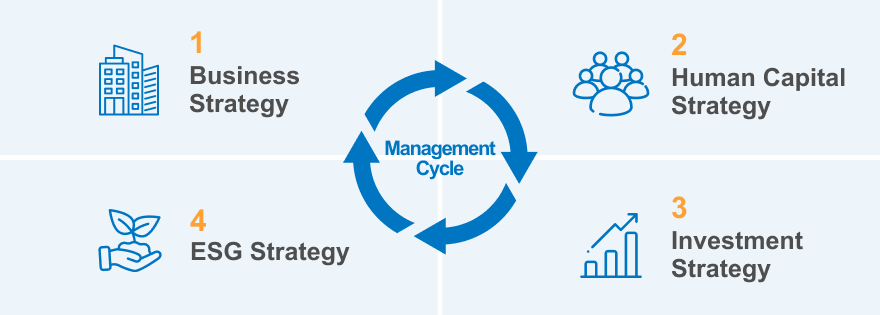
Management Strategy Overview
Creating a virtuous cycle toward sustainable growth
through the steady execution of each strategy
Business Strategy
Basic Policy
- Establishing an organizational structure to drive the Integration Business and the Solutions Business
- Developing six industry verticals and system infrastructure across both businesses
- Promoting initiatives to increase the end-user sales ratio and leverage AI across the organization
Integration Business
Stability × Expansion
- Improving quality and stabilizing earnings
- Expanding business through deeper customer relationships
Solutions Business
Challenge × Creation
- Strengthening R&D capabilities
- Establishing new business models
Social Infrastructure Domain
Banking / Securities / Credit, etc.
Business Deepening Domain
Insurance / Public Sector (Aviation), etc.
Business and Operations Domain
Distribution (Industrial), etc.
System Infrastructure (Cross-Industry)
Increasing End-User Sales Ratio
Leveraging AI
Leveraging AI
Objective 1: Apply AI-Driven Development to All Projects*
| Company-wide rollout of AI-driven development |
- Building technical expertise and standardization
- Internal knowledge sharing and application to other projects
|
*A development methodology that uses AI in one or more stages of the development process
| Development and deployment of proprietary AI solutions |
- Expansion of existing solutions
- Planning and development of new solutions
|
Human Capital Strategy
Target Organizational Profile
A team of engineers who fully harness AI
Engineers × AI → Sustainable Growth
Individual Initiatives
| Building a foundation for employee retention and continued success
|
- Periodic review of HR systems
- Obtaining Certified Health & Productivity Management Organization recognition
|
| Ongoing talent acquisition and development |
- Proactive recruitment of new graduates
- Training new graduates as AI-native professionals
|
| Promoting women’s career advancement |
- Enhancing flexible work arrangements
- Designing HR programs that exceed statutory requirements
|
| Strengthening the supply chain |
- Establishing a Partner Development Division
- Establishing collaboration based on quality and security
|
Investment Strategy
Growth Investment (3-Year Cumulative Total)
Approx. ¥5.0 billion
| AI-Related |
- Investing in organizational capabilities to advance AI-driven development and AI solutions
- Investing in streamlining and enhancing internal operations through AI
|
| Human Capital |
- Improving compensation, including reviews of salary and performance evaluation systems
- Strengthening talent recruitment
- Conducting in-house study sessions to enhance technical capabilities
|
| M&A |
- Assigning dedicated M&A personnel
- Making Coresoft Co., Ltd. a consolidated subsidiary
- Accumulating insights from ongoing PMI activities for the next M&A opportunity
|
ESG Strategy
Material Issues and Key Initiatives
| Material Issues |
Sub-Material Issues |
[Environmental]
1. Responding Responsibly to Climate Change |
Reducing greenhouse gas emissions |
| Introducing renewable energy |
| Decarbonizing the entire supply chain |
| Disclosure in line with frameworks such as TCFD |
[Social]
2. Building a Healthy and Rewarding Workplace by Strengthening Human Capital |
Securing and developing human resources, and supporting career development |
| Promoting diversity |
| Promoting health and productivity management and improving employee satisfaction |
[Social]
3. Enhancing Competitiveness by Strengthening Human Resources, Technology, and Partnerships |
Enhancing technical capabilities through human resource development |
| Building a sustainable value chain |
[Governance]
4. Practicing Sound Governance and Ethics |
Strengthening the corporate governance framework |
| Embedding compliance and corporate ethics |
| Strengthening risk management and information security frameworks |
Indicators for the Plan Period
Cash Allocation
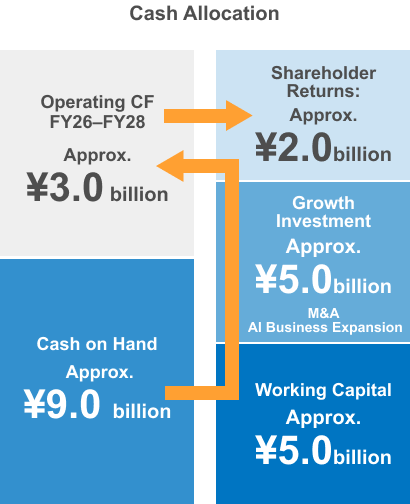
- Growth investments, including M&A, funded by cash on hand and cumulative operating CF over the three-year period
- Improving capital efficiency through shareholder returns
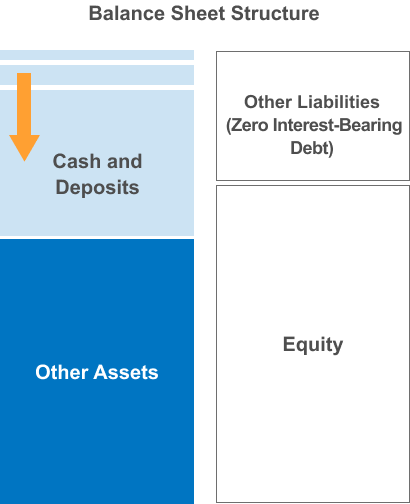
- Optimizing the level of cash and deposits through growth investment and shareholder returns
- Maintaining financial soundness through debt-free management
- Preserving management flexibility to prepare for future risks
Approach to Shareholder Returns
Basic Policy
Positioning the enhancement of corporate value over the medium to long term as the highest priority, while pursuing growth investment as the foundation and balancing shareholder returns with financial soundness
Continuing stable and appropriate returns to shareholders
Targeting a consolidated dividend payout ratio of around 40%
Trends in Dividend per Share and Dividend Payout Ratio