Basic principle
HIMACS has conducted its business based on a core management philosophy of fairness and independent initiative, fulfilling its responsibilities and obligations to shareholders, customers, employees, and society as a whole.
In accordance with the principles of Japan's Corporate Governance Code, HIMACS will seek sustainable corporate growth and development. Through highly transparent and efficient management and dialogue with stakeholders, we will provide information in a fair, timely, and accurate manner and continuously work to enhance corporate governance, recognizing it as a significant management priority.
Corporate Governance Report
Corporate Governance Structure
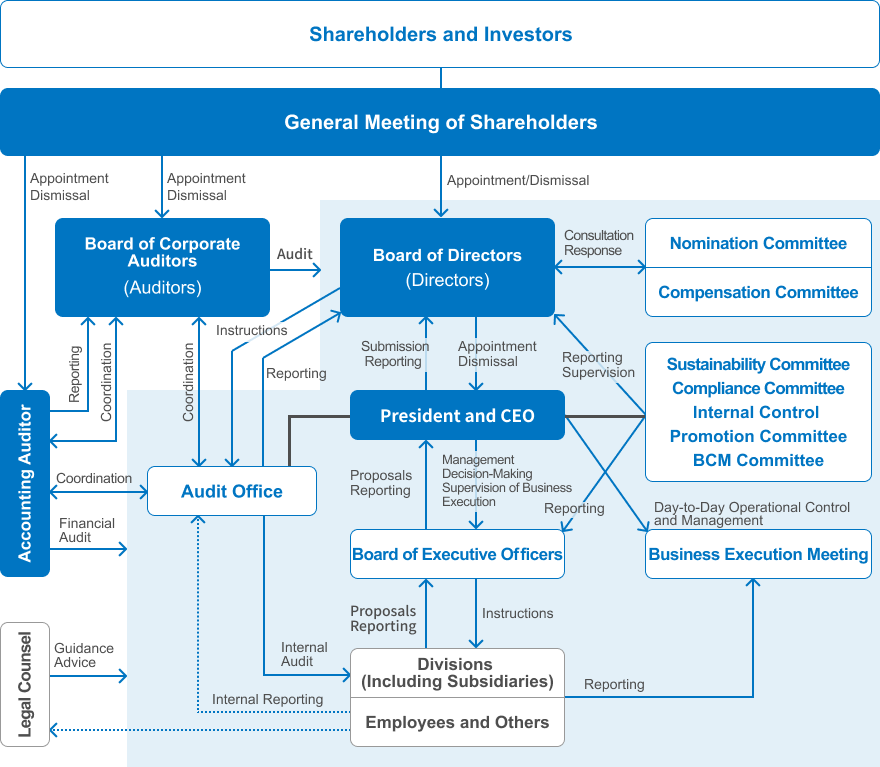
HIMACS has established a corporate governance structure comprising the General Meeting of Shareholders, the Board of Directors, the Auditors, the Board of Corporate Auditors, and the Accounting Auditor. In addition, we have introduced an executive officer system to clearly distinguish the Board of Directors’ decision-making and oversight functions from the business execution functions of each division, thereby improving management efficiency. To ensure objectivity, appropriateness and transparency in the decision-making process for the appointment of Directors and the determination of their compensation, we have established the Nomination Committee and the Compensation Committee, which are both non-statutory bodies in which a majority of the members are independent outside officers.
Board of Directors
The Board of Directors makes decisions on the Company’s business execution and supervises the performance of duties by Directors and Executive Officers. It holds regular meetings at least once a month and extraordinary meetings as necessary. Auditors also attend Board of Directors meetings and participate in discussions, thereby strengthening the Company’s management oversight function.
Board of Corporate Auditors
The Board of Corporate Auditors holds regular meetings at least once a month and special meetings from time to time as necessary to receive reports from the Auditors and to deliberate and decide on important audit matters.
Nomination Committee
To ensure objectivity, transparency and independence in the nomination of Director candidates, the Nomination Committee, a non-statutory body in which a majority of the members are independent outside officers, selects candidates from among individuals who possess the qualifications required of Directors in accordance with the appointment standards set forth in the Basic Policy on the Appointment of Directors, and submits proposals for their election to the Board of Directors.
Compensation Committee
To ensure transparency and fairness in determining Directors’ compensation, the a non-statutory Compensation Committee, a majority of whose members are independent outside officers, prepares draft proposals for individual compensation in accordance with the Officer Compensation Regulations. These proposals are then deliberated and determined by the Board of Directors.
Corporate Governance Structure
Reasons for adopting our current corporate governance structure
HIMACS has adopted the governance structure of a company with a Board of Corporate Auditors, as it considers the management oversight system provided by the Auditors to be effective.
The Company currently has seven Directors, including three Independent Outside Directors, and four Auditors, including three Independent Outside Auditors. Going forward, the Company’s policy is to maintain a Board of Directors in which Independent Outside Directors account for at least one-third of its members.
The Outside Directors have each held senior positions at companies in our industry. Based on their specialized knowledge and extensive experience, they are expected to provide adequate oversight of and advice on our corporate management.
The Board of Corporate Auditors comprises one Full-Time Auditor and three Outside Auditors (part-time). Each of them possesses extensive knowledge of our industry and expertise in areas such as finance and accounting, which allows them to conduct audits from a fair and independent standpoint.
We believe the current structure will further strengthen our corporate governance.