Material Issues
The HIMACS Group has identified issues that it needs to address as priorities by considering their importance to stakeholders, including customers, employees, business partners, shareholders, investors, and local communities, as well as their relevance to the Group’s management strategy. The Group identified its material issues through the following process.
1. Identification of Social Issues
- We then prepared a long list of social issues that HIMACS should address, based on issues identified from international guidelines,* ESG rating criteria, and other sources.
* GRI Standards, SASB, ISO 26000, SDGs, and other frameworks
2. Prioritization of Social Issues
- We created a materiality matrix by evaluating the social issues on the long list based on two axes: importance to stakeholders and importance to HIMACS. We then prioritized the issues accordingly.
3. Organization of Material Issues
- The selected social issues were organized into four categories based on their content and the direction of our initiatives, and a draft set of material issues was prepared.
4. Validation and Identification of Material Issues
- We exchanged views with management on the draft material issues and the development process, and validated their appropriateness.
- The material issues and grouping were approved by the Board of Directors and identified as HIMACS’s material issues.
In identifying its material issues, the Group evaluated social issues along two axes: “importance to stakeholders” and “importance to HIMACS,” and created a materiality matrix.
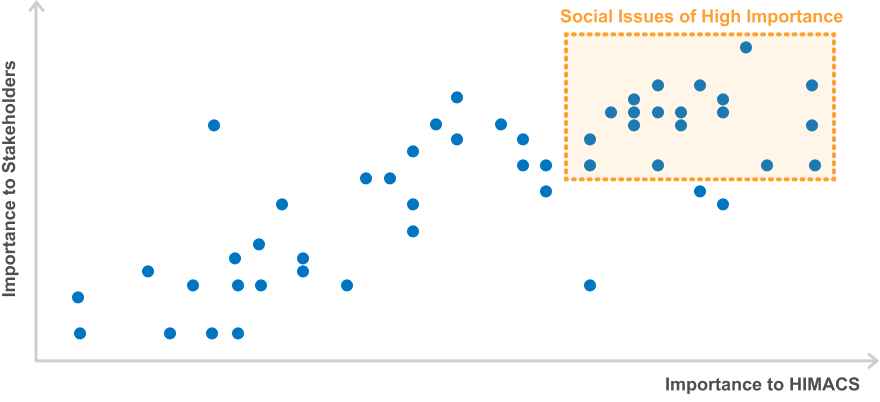
The HIMACS Group has identified issues that it needs to address as priorities, or material issues, by considering their importance to stakeholders, including customers, employees, business partners, shareholders, investors, and local communities, as well as their relevance to the Group’s management strategy. Through initiatives to address these material issues, the Group aims to contribute to achieving the Sustainable Development Goals (SDGs) established by the United Nations.
The material issues identified by the Group, together with an overview of related risks and opportunities, impact, time horizon, and main initiatives, are as follows.
Notes:
1. Impact: High (significant), Medium (important), Low (minor). Overall assessment considering the likelihood of occurrence and other factors.
2. Time horizon: Short term (2026–2028, the current medium-term management plan period), Medium term (through 2030), Long term (2031 and beyond).